
Reducing Water Usage in Data Centers
A large data center can withdraw millions of gallons a day for cooling and AI workloads keep pushing that figure higher. Regulators and water-strapped communities now watch that consumption closely and new projects answer for it before construction even starts. Cutting usage and protecting uptime at the same time is a hard problem with no single fix.
At ProChemTech, reducing water usage in data centers is achieved through our proprietary and patented chemical formulations. Our proven treatment programs also cut discharge volumes and extend equipment life so the savings hold up over time. Read on to learn more about reducing water usage in data centers.
Get a Quote for Reducing Data Center Water Usage
Challenges of Reducing Data Center Water Usage
Cooling accounts for most of the water a data center draws from municipal or groundwater sources. A large facility can withdraw millions of gallons in a single day. AI training and inference workloads are driving that consumption even higher thanks to more complex models.
Cutting that consumption means dealing with a wide range of challenges at the same time:
- Evaporative cooling: Data center developers most commonly choose air cooling through water evaporation, a water-intensive practice that withdraws fresh water directly from blue sources, according to the Environmental and Energy Study Institute.
- Town-scale consumption: Large hyperscale sites can draw up to 5 million gallons in a single day, equal to the daily use of a town with 10,000 to 50,000 residents.
- Shrinking availability: Drought and water shortages are reducing the fresh water available in many regions, even as data center demand for that same water keeps climbing.
- Mandatory disclosure: The European Commission now requires large data centers to report annual water use data, and several US states have introduced similar disclosure bills of their own.
- Untracked usage: Fewer than one-third of data center operators measure and track their own water consumption, leaving many projects unable to quantify the reduction they’re being asked to make.
ProChemTech Chemistry Cuts Cooling Tower Water Waste
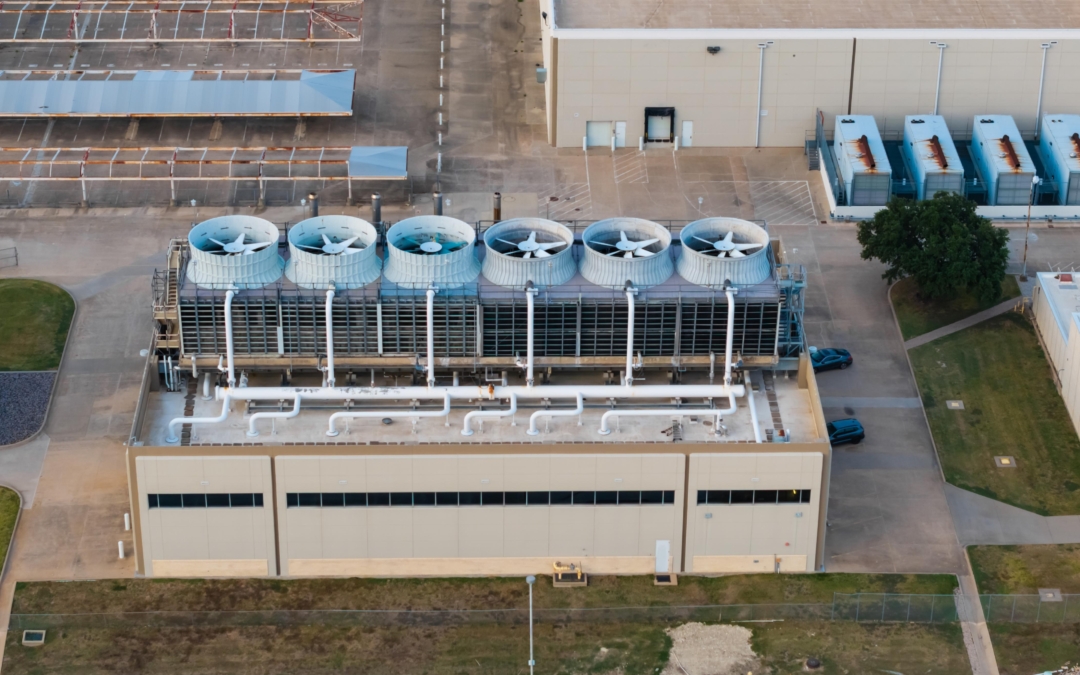
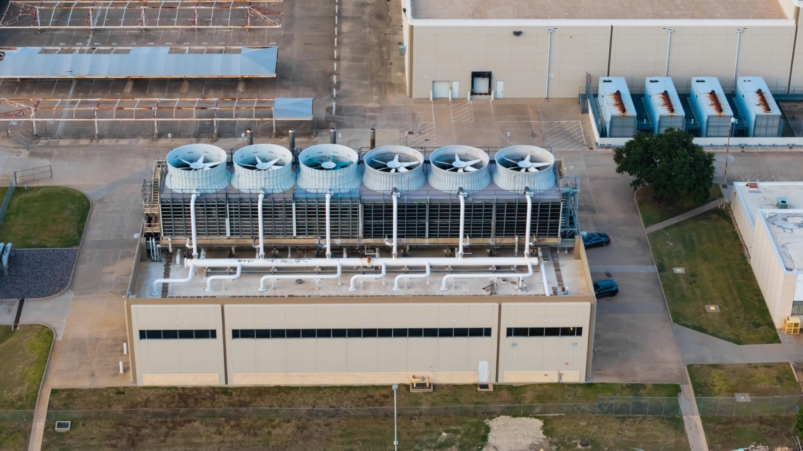
Cooling towers are the largest source of water consumption in data centers. ProChemTech helps reduce water usage there through chemistry and equipment built for high-cycle operation. Cycles of concentration measure how many times water recirculates before it needs replacement. Raising that number is the primary lever for cutting a tower’s water use.
Pushing cycles of concentration higher raises the cooling water’s pH. That shift creates a tradeoff: better Legionella control, but higher corrosion risk on tower components. ProChemTech’s patented technology for minimal and zero-blowdown tower operation addresses that risk.
Aqua Ionic
Aqua Ionic uses softened makeup water to remove impurities and minerals from the system before it enters the towers. Removing those minerals lifts the ceiling on cycles of concentration from the standard range of 2 to 4 up to 8 to 10. Legionella sampling across 17 towers running Aqua Ionic came back with none detected. That result matches published research showing Legionella cannot survive above pH 9.2.
Aqua Save
Aqua Save is another one of our proprietary formulations and is ideal for systems running without softened water trying to meet higher cycles of concentration without acidic inhibitors.
GalvaGard
GalvaGard is a corrosion inhibitor built to protect galvanized cooling tower components. Above pH 8.2, untreated galvanized steel loses its zinc coating quickly. GalvaGard controls corrosion, and continuous dosing keeps galvanized surfaces protected during high-cycle operation.
|
Chemistry Category |
Function |
| Scale Inhibitors |
Prevent mineral deposits from forming on heat-transfer surfaces |
|
Biocides |
Control bacterial and microbial growth in circulating water |
|
Stabilized Bromine |
Stays effective at high pH, where chlorine loses much of its biocidal power |
| Dispersant Polymers | Keep suspended solids from settling and fouling equipment |
|
pH Adjustment Reagents |
Maintain cooling water within a target range |
Engineering Water Efficient Cooling for New Data Centers
Hyperscale data centers can require 10 or more cooling towers. ProChemTech’s Engineered Systems Division builds the pump skids, heat exchangers, and filtration equipment for these systems. This equipment carries a 5-year corrosion warranty.
Our talented engineers manage both the tower hardware and the chemical program as a single source. Control panels connect to a facility’s Building Management System for centralized monitoring. ProChemtech works with all major cooling tower manufacturers to find the most efficient design for the customer’s facility.
Protecting Closed Chilled Water Loops From Corrosion
Some of the water in a data center never reaches the cooling tower. That portion circulates through a closed chilled water loop between the chiller plant and the server floor and runs for months on almost no fresh makeup. Evaporation barely touches a closed loop so scale stays minor and the real threats become dissolved oxygen and microbiologically influenced corrosion.
We treat these loops with corrosion inhibitors and biocides built for closed systems and glycol-based designs. That chemistry keeps oxygen from pitting the piping and stops corrosion debris from clogging heat exchanger channels. The result is uptime and longer equipment life rather than water savings and proving water performance is quickly becoming a regulatory task.
ProChemTech Helps Datacenters Save Water
Reducing water usage in data centers comes down to the cooling tower and the systems around it. Higher cycles of concentration and blowdown reuse and disciplined chemistry management deliver the savings and keep them in place.
ProChemTech builds the chemistry programs and cooling systems behind those savings. Our engineers review your makeup water and your tower data and tell you where the savings are.
Click below for a quote and to learn more about reducing water usage in your data center.