
Corrosion Control in Cooling Towers
TL;DR – Top Level Article Summary
- Increasing the number of concentration cycles reduces water use and concentrates dissolved solids in the recirculating tower water. The same shift often raises pH and alkalinity, which can accelerate zinc corrosion on galvanized steel and increase the risk of white rust.
- Passivation programs and phosphate-based treatments often stop working once cooling water pH rises above 8.2. Increasing phosphate or phosphonate levels can worsen white rust corrosion rather than control it.
- GalvaGard is an acid-free inhibitor technology for high-pH, high-alkalinity cooling tower water. It protects galvanized steel over many cycles and supports corrosion control without relying on acid feed as the primary method of pH management.
How Water Conservation Changes Cooling Tower Chemistry
Facility managers often have to balance water conservation goals with equipment protection. Higher cycles of concentration can reduce water use and wastewater discharge, but the resulting chemical shift can increase the risk of white rust on galvanized components if the treatment program is not designed for high-pH, high-alkalinity operation.
Western states such as Arizona, California, Nevada, and New Mexico face some of the toughest water rules in the nation. That pressure is driving more facilities to operate at higher cycles of concentration to save water. ProChemTech provides proprietary corrosion control in cooling towers designed for modern high-cycle environments.
Our programs are designed to perform with makeup water ranging from softened to extremely hard. For facilities pursuing water savings, softened makeup water can support higher-cycle operation when the chemistry is designed for high-pH, high-alkalinity conditions.
Read on to learn how our advanced solutions can prevent white rust, extend the life of your equipment, and protect galvanized surfaces in alkaline high-cycle water.
Get a Quote for Corrosion Control in Cooling Towers
What White Rust Is and Why It Causes Failure
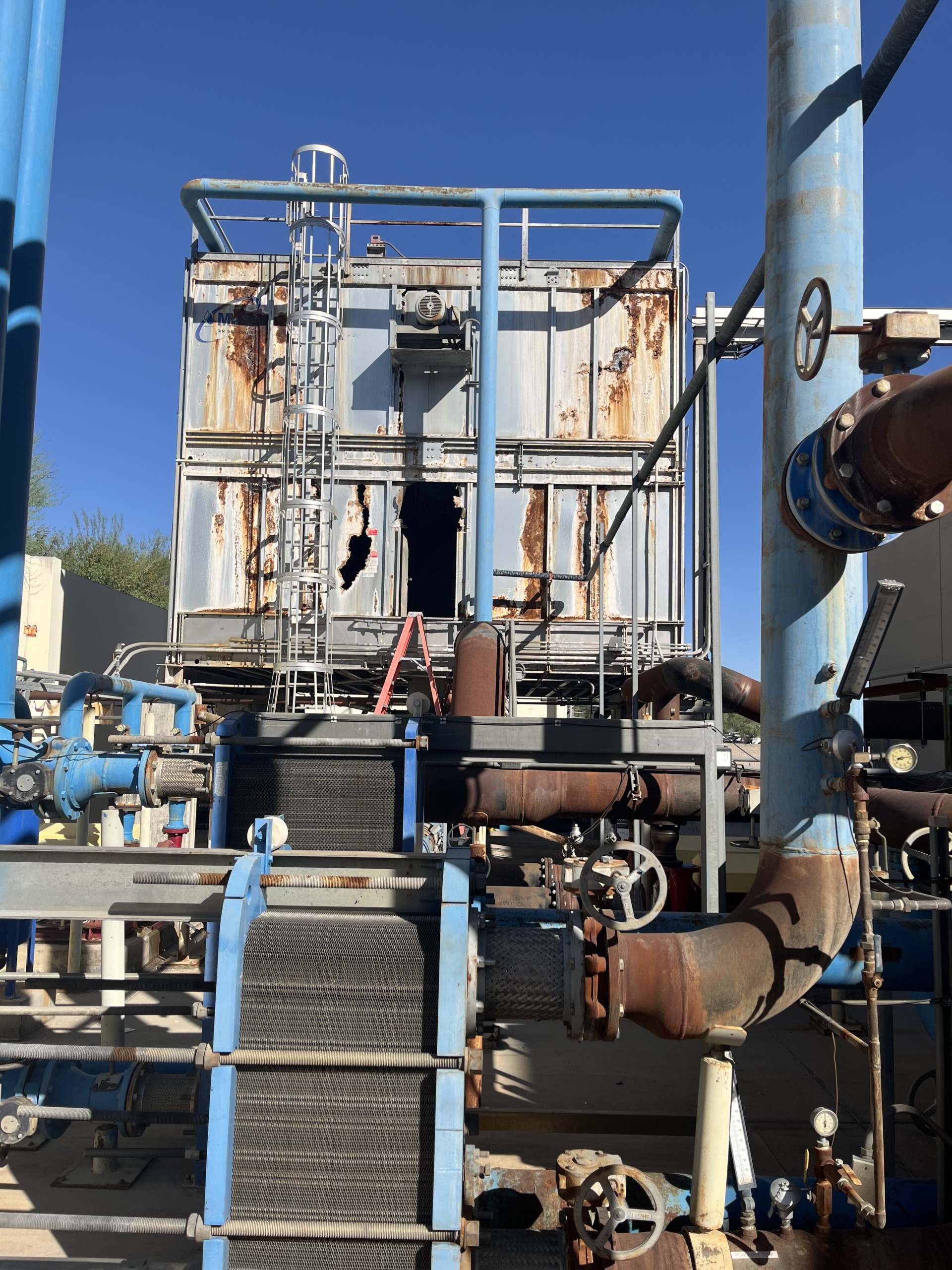
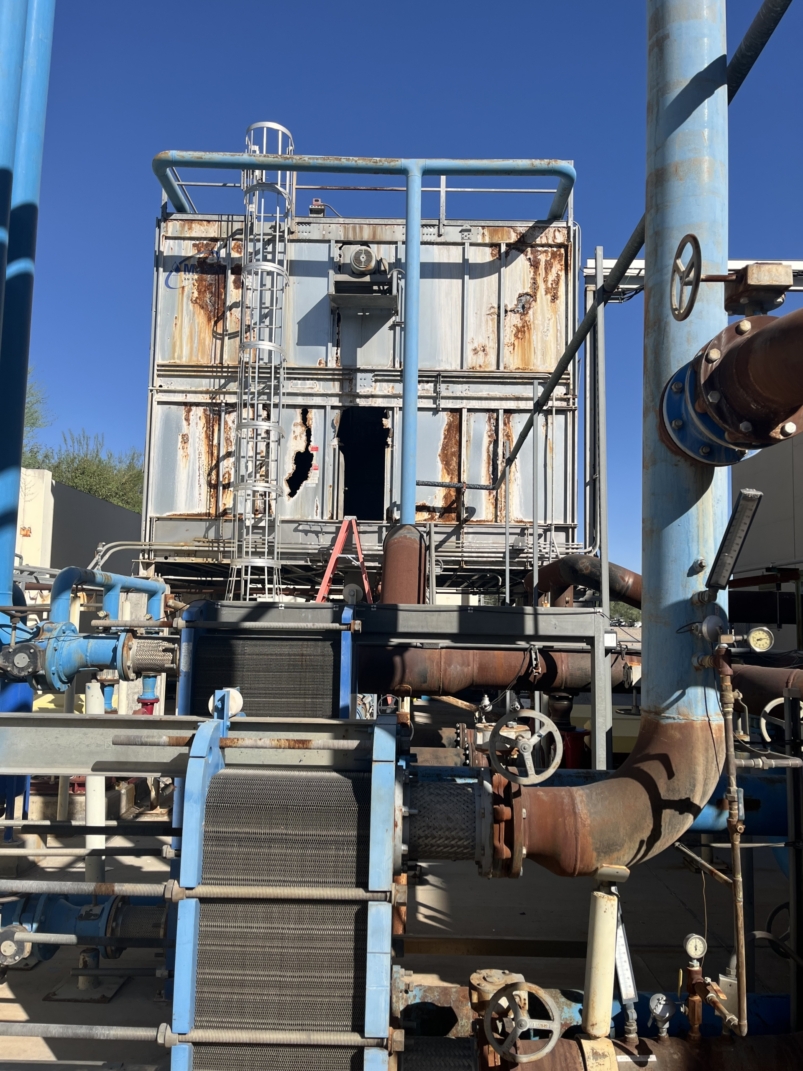
White rust is the common name for zinc corrosion; the products of corrosion typically appear as a white to dirty gray, voluminous deposit below the water line on galvanized steel surfaces exposed to recirculated water. The white color is due to the formation of zinc carbonate, which does not form a corrosion-limiting protective film on the base metal.
Due to the lack of protective film formation, white rust will continue to form until the protective zinc is entirely removed from the underlying steel, leaving the steel susceptible to accelerated corrosion (red rust) and premature failure.
How High Cycle Operation Triggers White Rust
Shortages of fresh water, rising costs of water and wastewater disposal, and stringent environmental requirements for discharges have created a desire to minimize both water use and wastewater discharge. One common and very effective method to reduce both water use and wastewater discharge is to increase the concentration cycles (COC) at which cooling towers, one of the largest water users, operate.
The pH and Alkalinity Shift at Higher Cycles
Increasing the COC at which a cooling tower is operated increases the pH and alkalinity of the recirculated water. Operation of cooling towers at these higher pH and alkalinity values has led to the identification of a new form of corrosion, “White Rust”.
Water Conditions That Increase White Rust Risk on Galvanized Steel
| Contributing Factor | Effect on System | White Rust Risk |
| High pH (above 8.2) | Higher pH in recirculated water | White rust becomes more likely and can accelerate on galvanized surfaces |
| High alkalinity | Buffers the water and makes it harder to lower the pH | Higher alkalinity can increase the zinc corrosion rate |
| Higher cycles of concentration | Concentrates the recirculating water chemistry | High-cycle operation can move systems into conditions that promote accelerated white rust |
| Accelerating agents such as phosphates and phosphonates | Can be present in some treatment approaches | These agents can substantially increase the white rust corrosion rate in alkaline conditions |
Why the Problem Has Become More Common
In the past, when pH control via acid feed was used for scale control, chromium was the corrosion inhibitor of choice, and lower COC; white rust was rarely seen and thus not recognized as a specific problem. With the safety and control problems associated with acid use, the USEPA ban on chromium-based water treatments, and the general increase in COC to conserve water, many more cooling towers are now operated with alkaline water chemistry, placing them in pH and alkalinity ranges that promote accelerated white rust.
To add to the problem, around 1989, the USEPA began requiring zinc galvanizing plants to change the composition of the molten metal “bath” used to produce galvanized steel by reducing the lead content to trace levels. The resulting reduction in the lead content of galvanized steel produced by the new low-lead baths is believed to make it even more susceptible to white rust in alkaline water.
The Limitations of Conventional White Rust Control
Once the problem of white rust was recognized, water treatment companies attempted to control it by adding acid to lower the pH below the critical 8.2 point, using higher levels of traditional corrosion inhibitors, pretreating the cooling tower with various phosphate-based products, and reducing COC. Cooling tower manufacturers have responded by providing cooling towers fabricated from stainless steel, fiberglass, and plastic, eliminating the use of galvanized steel.
Why These Fixes Fall Short at Higher Cycles
Unfortunately, none of these “cures” has been successful in providing a simple, cost-effective, and reliable solution to this problem while maintaining a higher COC. Feeding acid to cooling towers still presents safety and control challenges, and pH adjustment with popular all-organic cooling water chemistries can be unforgiving under high-cycle conditions.
Laboratory testing of traditional corrosion inhibitors, such as phosphates and phosphonates, has shown that higher concentrations of these materials accelerate white rust corrosion, whereas pretreatment passivation does not prevent it. Of course, reducing COC is counterproductive to reducing water use and wastewater discharge.
Another aspect of COC reduction is that it also substantially increases the use of water treatment chemicals. Needless to say, the cooling towers fabricated from corrosion-resistant materials are substantially more costly than galvanized units.
Why Standard Passivation Methods Fail
Traditional recommendations for preventing corrosion on new towers often prove inadequate in real-world conditions. Running a tower at pH 7.0 to 8.2 for weeks is often impractical when water conservation goals require higher cycles.
Ortho-phosphate treatments generally do not prevent corrosion once the pH exceeds 8.2. Some chemical approaches, including certain phosphonates and dispersant programs, can increase white rust corrosion rates under high-pH, high-alkalinity conditions.
The False Security of Initial Protection
Relying on initial passivation can be misleading. The tower can still corrode during standard high-pH operation when the system returns to high-cycle operation.
Common Approaches and Tradeoffs at Higher Cycles
| Approach | Why is it used? | Why does it fall short? |
| Acid feed to lower pH | Forces pH below the critical point | Safety and control risks increase, and overfeeding can cause rapid damage |
| Higher phosphate or phosphonate levels | Traditional inhibitor strategy | Higher concentrations can accelerate white rust corrosion |
| Pretreatment passivation | Startup protection attempt | Often does not hold once high-cycle alkaline operation resumes |
| Reduce COC | Lowers pH and alkalinity | Increases water use and wastewater discharge, and can increase chemical usage |
| Switch to alternative tower materials | Avoids galvanized zinc | Higher capital cost compared with galvanized units |
GalvaGard: A Proven Alternative to Traditional White Rust Treatments
Recognizing the need for a simple, reliable cure for the white rust problem, ProChemTech initiated research into new corrosion inhibitors. These efforts were successful: a new inhibitor technology, GalvaGard™, was discovered in 1994 after two years of research.
This unique technology is available in a wide array of ProChemTech formulations suitable for makeup waters ranging from soft to extremely hard and with any level of alkalinity. GalvaGard has also been formulated as an adjunct to existing water management programs and is available as a concentrate for toll product blenders and other water management firms.
Cooling Tower Corrosion Control FAQ
Q: What pH level increases white rust risk in cooling towers?
A: White rust risk increases when cooling water pH rises above 8.2, especially under high alkalinity conditions.
Q: What is the difference between white rust and red rust?
A: White rust is corrosion of the zinc coating on galvanized steel. Red rust is corrosion of the underlying steel after the zinc protection is lost.
Q: Can cooling towers control white rust without using acid feed?
A: Yes. White rust control can be achieved with inhibitor technology designed for high-pH, high-alkalinity tower water, such as GalvaGard, as part of a complete water treatment program.
Q: What can accelerate white rust under high pH and high alkalinity conditions?
A: Higher cycles concentrate tower water chemistry, and certain accelerating agents, such as phosphates and phosphonates, can increase white rust corrosion rates in alkaline conditions.
Achieve Long-Term Corrosion Control with ProChemTech
Effective corrosion control in cooling towers requires more than standard passivation methods. Operators must address the chemical conditions created by higher cycles of concentration, including elevated pH and alkalinity, which can increase the risk of white rust on galvanized steel.
ProChemTech developed GalvaGard to protect galvanized surfaces in high-pH, high-alkalinity cooling tower water as part of a complete treatment program. Our solutions help facilities pursue water savings while maintaining reliable corrosion control.
Click below to request a quote and learn more about our customized water treatment programs.